
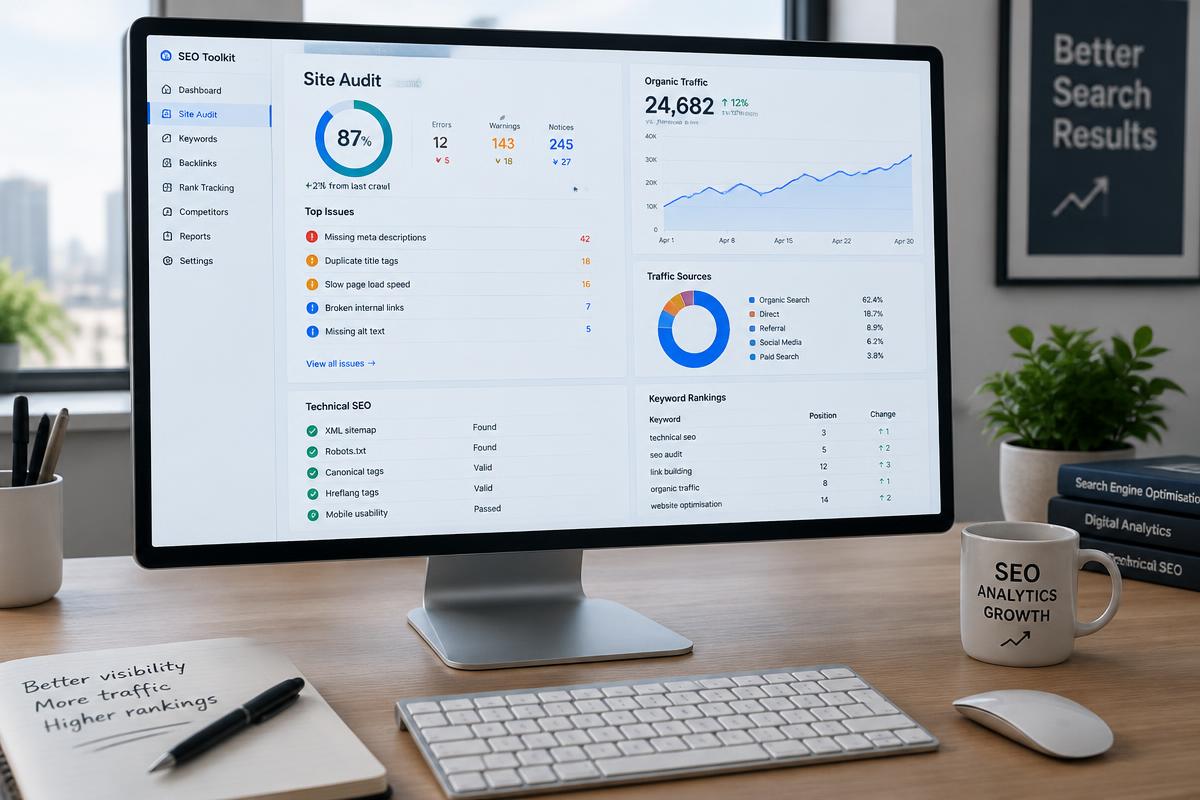
Search visibility depends on whether systems can discover, understand and trust a website. Technical search optimisation works best when content, design and engineering share responsibility for accessible structure and useful performance.
Search visibility depends on technical foundations as much as content. If search engines cannot crawl, render and understand a site, even excellent content will struggle to rank.
We treat technical search optimisation as part of engineering, built into architecture, templates and release processes.
Make valuable pages discoverable
Clear internal navigation, accurate site maps and intentional indexing rules help search systems find the right content. Duplicate or low value pages can dilute signals and waste crawl attention. Every public route should have a clear purpose.
Express meaning in the page
Descriptive titles, headings, links and structured information help people and machines understand content. Semantic markup should reflect the visible page rather than invent claims. Consistency between metadata and the actual experience builds trust.
Improve the real experience
Speed, stability and mobile usability affect both people and search performance. Teams should monitor important page types using field evidence and correct systemic causes. Useful content and sound engineering reinforce each other over time.
Crawlability and indexing
Clean URL structures, accurate sitemaps, correct robots rules and canonical tags help search engines discover and index the right pages. Duplicate and thin pages should be consolidated or excluded.
Rendering and speed
Server rendered or static pages provide complete content to crawlers immediately. Fast loading and stable layouts improve both rankings and user experience, measured by Core Web Vitals.
Structured data
Schema markup describes organisations, articles, products, events and frequently asked questions in a machine readable way. This can enable rich search results that attract more clicks.
Content architecture
Logical page hierarchy, descriptive titles, unique meta descriptions, clear headings and internal links help both people and search engines understand topics and relationships.
Recommended technology
Tools we use and why
Google Search Console
Indexing status, search performance and issue reports.
Screaming Frog
Comprehensive site crawling and auditing.
Ahrefs and Semrush
Keyword research, backlinks and competitor analysis.
PageSpeed Insights
Core Web Vitals measurement.
Schema.org
Standard vocabulary for structured data.
Server side rendering frameworks
Crawler friendly complete HTML delivery.
Step by step approach
How we deliver it
- 1Audit crawling, indexing, speed and structure.
- 2Fix critical technical issues first.
- 3Improve templates with titles, headings and structured data.
- 4Optimise performance and Core Web Vitals.
- 5Strengthen internal linking and content hierarchy.
- 6Monitor search performance and add checks to releases.
Avoid these
Common mistakes
- Relying on client side rendering for important content.
- Using identical titles and descriptions across pages.
- Changing URLs without redirects.
- Ignoring mobile performance.
Measure success
Key metrics
- Indexed pages versus intended pages.
- Organic clicks and impressions.
- Core Web Vitals pass rate.
- Rankings for priority topics.
Practical priorities
What technology leaders should carry forward
- Control discovery and indexing intentionally
- Use semantic structure that matches visible content
- Improve performance across real page types
Questions answered
Frequently asked questions
How long does SEO take to show results?
Technical fixes can show effects within weeks, while broader ranking growth usually builds over several months.
Do you write content as well?
We focus on technical foundations and content structure, and collaborate with content teams on topics and quality.
Will a redesign hurt our rankings?
Not if URLs, redirects, metadata and performance are planned carefully before launch.
SJ Dev Technologies perspective
Durable search performance is created by a useful, understandable and technically dependable website. It is an ongoing product discipline rather than a one time checklist.