
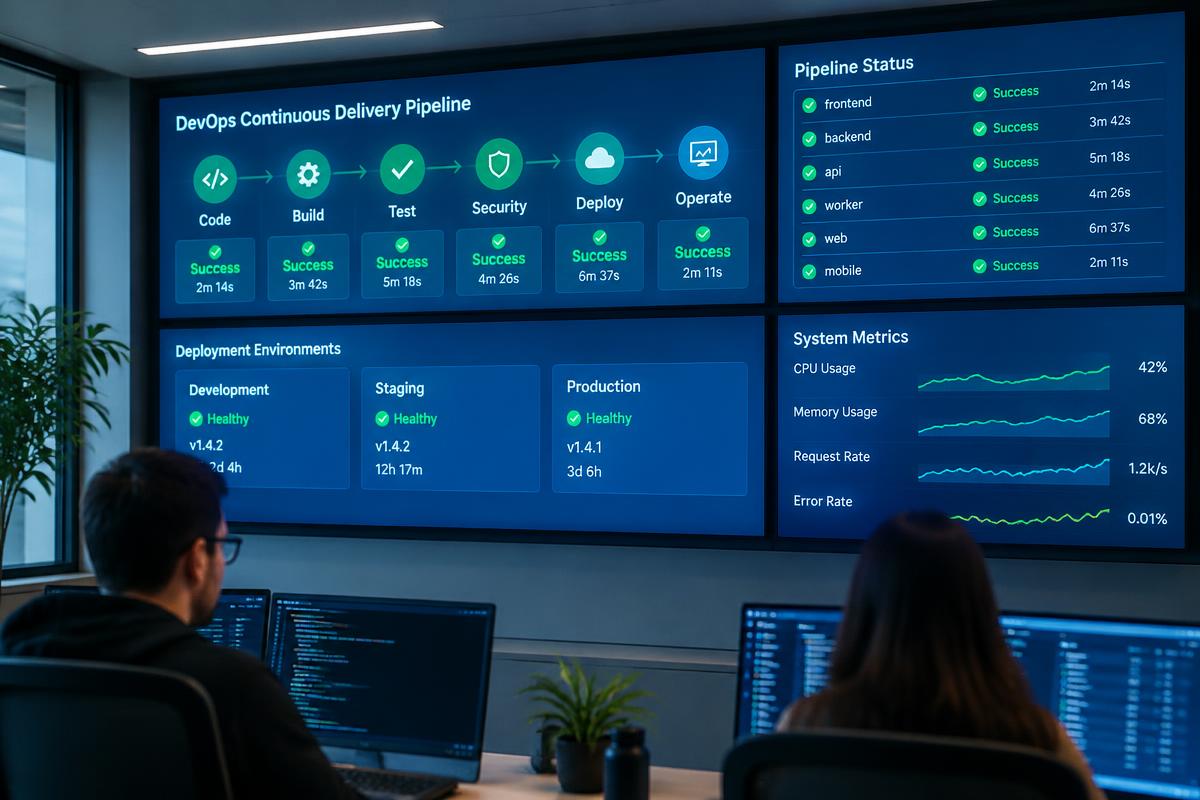
DevOps is not a collection of deployment tools. It is a working model that shortens the distance between a product decision and reliable customer value while keeping responsibility visible across the team.
Continuous delivery is the ability to release changes to users safely and quickly at any time. It is not about speed alone. It is about confidence that each change has been built, tested and deployed in a consistent way.
We build delivery pipelines and team habits that turn releases from rare stressful events into routine daily activity.
Automate the repeatable path
Build, test, security checks and environment changes should run consistently. Automation reduces manual variation and creates an auditable route to production. It should remain understandable enough that teams can diagnose failures without relying on one specialist.
Release in controlled increments
Small changes are easier to review, test and recover. Feature controls, staged delivery and clear rollback plans limit the effect of unexpected behaviour. Release speed is useful only when the organisation can respond safely.
Learn from production signals
Logs, metrics and traces should answer questions about customer journeys and service health. Alerting needs clear ownership and actionable thresholds. Regular review turns operational evidence into better architecture and delivery decisions.
Trunk based development
Short lived branches merged into the main branch frequently reduce painful merge conflicts and keep everyone working on current code. Feature flags allow incomplete work to be merged safely while remaining hidden from users until it is ready.
Automated pipelines
Every change should automatically build, run tests, scan for security issues and produce a deployable artefact. The same artefact is promoted through testing and production environments, which removes the risk of differences between what was tested and what was released.
Safe deployment strategies
Blue green deployments, canary releases and progressive rollouts expose changes to a small group first. Automated health checks can stop or reverse a rollout when error rates rise. Rollback should be a single simple action that anyone on the team can perform.
Learning from incidents
Blameless reviews after incidents focus on how the system allowed a problem rather than who caused it. Actions from these reviews improve tests, monitoring and processes so that the same class of problem becomes less likely over time.
Recommended technology
Tools we use and why
GitHub Actions
Pipelines tightly integrated with source control.
GitLab CI
Complete delivery platform with built in registry and security scanning.
Docker
Consistent packaging of applications and dependencies.
Argo CD
GitOps based continuous deployment to Kubernetes.
LaunchDarkly
Feature flag management and progressive delivery.
Grafana
Dashboards connecting deployments with system health.
Step by step approach
How we deliver it
- 1Measure current lead time, deployment frequency and failure rate.
- 2Move the team to short lived branches and frequent merging.
- 3Automate build, test and security checks for every change.
- 4Introduce progressive deployments with automated health checks.
- 5Adopt feature flags for controlled releases.
- 6Run blameless incident reviews and track improvement actions.
Avoid these
Common mistakes
- Treating DevOps as a tool purchase rather than a way of working.
- Keeping long lived branches that drift for weeks.
- Having manual deployment steps known only by one person.
- Ignoring flaky tests until nobody trusts the pipeline.
Measure success
Key metrics
- Deployment frequency of at least daily for active products.
- Lead time from commit to production under one day.
- Change failure rate below fifteen percent.
- Time to restore service under one hour.
Practical priorities
What technology leaders should carry forward
- Automate repeatable delivery checks
- Keep releases small and recoverable
- Connect production signals to customer journeys
Questions answered
Frequently asked questions
Is continuous delivery safe for regulated industries?
Yes. Automated pipelines create a clear audit trail and consistent controls, which often satisfies auditors better than manual processes.
How long does it take to adopt?
Initial pipelines can be running within weeks, while cultural habits usually mature over a few months.
Do we need Kubernetes?
Not necessarily. Many products deploy perfectly well to managed platforms or serverless environments.
SJ Dev Technologies perspective
Continuous delivery becomes a business capability when teams can release, observe and recover with confidence. Tools support that system, but shared ownership makes it dependable.